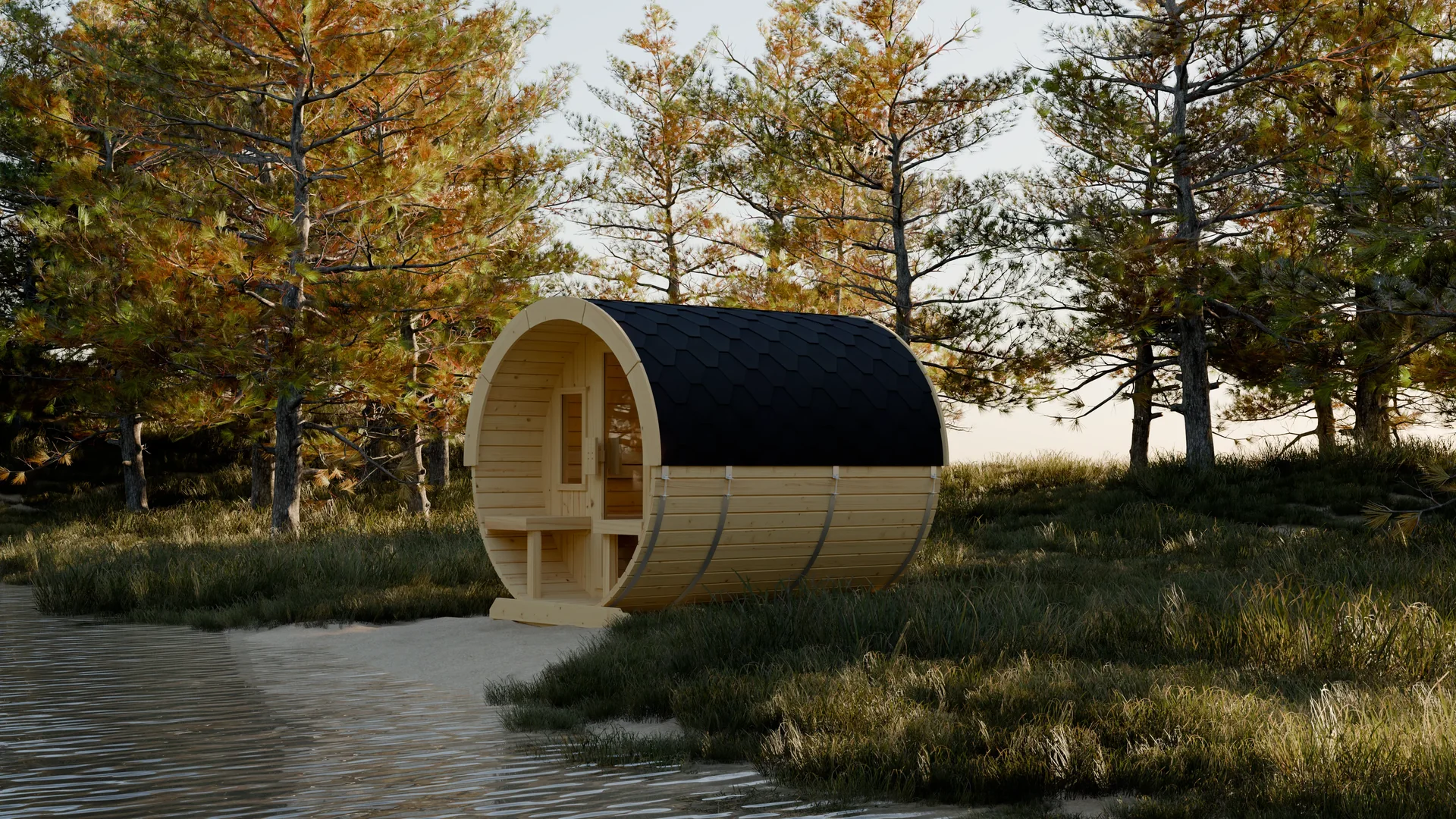
A sauna 3D visualization from me costs EUR 250 per sauna model, and the first render usually lands about 3 days after your files arrive. That number gets questioned from both sides. Some manufacturers expect a catalogue render to cost twice that, because their last agency charged per image and per revision. Others expect it to cost EUR 50, because they've seen someone on a marketplace offer "photoreal sauna, 24 hours". So here's what actually goes into the EUR 250, where the hours go, and when the price changes.
Short version: most of the cost is modelling the timber honestly.
Where the hours go on one sauna model
People assume the render itself is the expensive part. It isn't. A finished scene renders in Blender Cycles in somewhere between 20 and 60 minutes per 4000 px frame on my machine, and I don't really bill for the computer sitting there humming. The time goes into the parts nobody sees as "work".
Roughly, on a typical outdoor cabin or barrel sauna, my time splits like this:
- Reading the drawings and listing what's missing: 30 to 60 minutes.
- Modelling the shell, door, windows, benches, heater and roof: the biggest block, often 4 to 6 hours.
- Wood materials, grain direction, knots and the slight colour shift between boards: 1 to 2 hours.
- Lighting, camera and environment matched to your catalogue: 1 to 2 hours.
- Test renders, fixing the things that look wrong, final output: another hour or two.
That's a working day and a half, give or take, which is why EUR 250 is a fair number for me and not a loss-leader. It also explains why the 24-hour offers exist. If you skip the reading, use a generic barrel from an asset library and slap a stock pine texture on it, you can finish in an afternoon. It just won't be your sauna.
Why timber is the expensive bit
Wood is unforgiving in a render. A kitchen worktop can be one big slab of texture and nobody notices. A sauna is hundreds of boards, and every one of them needs its grain running the right way, a slightly different tone, and a believable gap or tongue-and-groove joint where it meets the next one. Get that wrong and the cabin reads as a plastic toy.
I model the staves or cladding boards as separate pieces, not as one cylinder with a striped texture. On a barrel sauna that's typically 40 to 60 staves plus the end walls, bands and the bench slats inside. A thermo-wood cabin with horizontal cladding can easily be 150 boards per side. It sounds like overkill (and for a thumbnail on a phone, maybe it is) but the moment someone zooms into your product page, the difference between real boards and a painted stripe is obvious.
Last spring a sauna maker sent me a single PDF drawing with overall dimensions and a photo of a prototype in a muddy yard. The drawing said "spruce". The photo was clearly thermo-treated, much darker, with that slightly scorched look. I asked before I modelled anything, and it saved us a full revision round. That one question is a good part of what the price covers.
What's included, and what isn't
For the EUR 250 you get one sauna model built from your drawings, rendered to match the look of your existing catalogue, with two consolidated revision rounds. "Consolidated" matters. It means you collect everyone's comments (sales, the owner, the person who builds them) into one list per round, and I fix them in one pass. Views, resolution, revisions and usage rights are confirmed in writing before I start, so there's no surprise invoice later.
What changes the quote:
Extra views or extra rounds of changes are quoted separately. So is a completely new environment, like moving a cabin from a garden lawn to a snowy lakeside scene with a jetty. Interiors are a separate camera with their own lighting, and a convincing interior with a glowing heater, steam haze and a towel on the bench is genuinely more work than another exterior angle. I'll tell you up front if your request crosses one of those lines.
What doesn't change it: the sauna being small. A 2-person barrel and a 6-person cabin take a similar amount of modelling time, because the effort scales with the number of distinct parts, not with cubic metres.
The mistake that costs manufacturers the most
Ordering one model at a time with a different look each time.
I see this constantly. A manufacturer gets three models rendered by three different people over two years, and the catalogue ends up with one sauna at golden hour, one on a white studio background and one in a forest that looks like a video game. Each render might be fine on its own. Side by side they make the range look like it comes from three different companies.
The fix is cheap. Send me two or three of your current catalogue images as references and I work towards the same camera height, lens, lighting mood and background. I keep the scene file, so model number seven sits next to model number one without anyone noticing it was made months later. When I did a run of 20 catalogue visualisations for a German manufacturer, that consistency was most of the value. The individual renders were the easy part.
Is EUR 250 cheaper than a photo shoot?
Usually, yes, but that's not really the point. A proper outdoor shoot needs the sauna built, transported, set up somewhere pretty, and good weather on the day. If the product changes colour next season you either reshoot or you live with the old photo. With a model you change the wood, swap the door glass from clear to bronze, or add the panoramic window option, and render again from the same camera.
Where a photo still wins: when you've already got a finished unit in a beautiful location and a photographer who knows what they're doing. I'd never tell a manufacturer to throw that away. Renders are best for the models that don't physically exist yet, the variants you can't afford to build just for a photo, and the cutaway or exploded views that a camera simply can't take.
What I'd actually do if I were ordering
Start with your best-selling model, not your newest one. You know exactly how it should look, so you'll spot anything wrong in my first render quickly, and that render becomes the reference for every model after it.
Send the files you already have, even if they're messy. A STEP or DWG from your production drawings is ideal. A PDF with dimensions, a few photos of a built unit and a list of wood species and heater models is honestly enough to start. I'll list the gaps after the first read, usually in a short email with four or five questions.
Decide early which variants you'll need. If you sell the same cabin in spruce and thermo-wood, with and without a porch, tell me before modelling. Building the model so the porch is a separate piece takes minutes at the start and an hour of untangling later.
And keep your revision comments specific. "The wood looks too orange" is useful. "Make it pop" isn't, and it'll eat a round.
If you'd like to see the kind of mood that works well for outdoor cabins, I wrote about it in creating atmospheric 3D sauna concepts. The same lighting principles carry over to the clean product shots I do under 3D product rendering, just with a studio backdrop instead of a forest.
When you've got a model in mind, the details of how I work are on the sauna visualization for manufacturers page. Send over the drawings and a couple of catalogue images through the contact form, and I'll tell you honestly whether it fits the EUR 250 or what would change it.