Blog / Case Study
Luxury Marble Bathroom Interior Visualization
Published January 2026 · Estimated read: 4 minutes
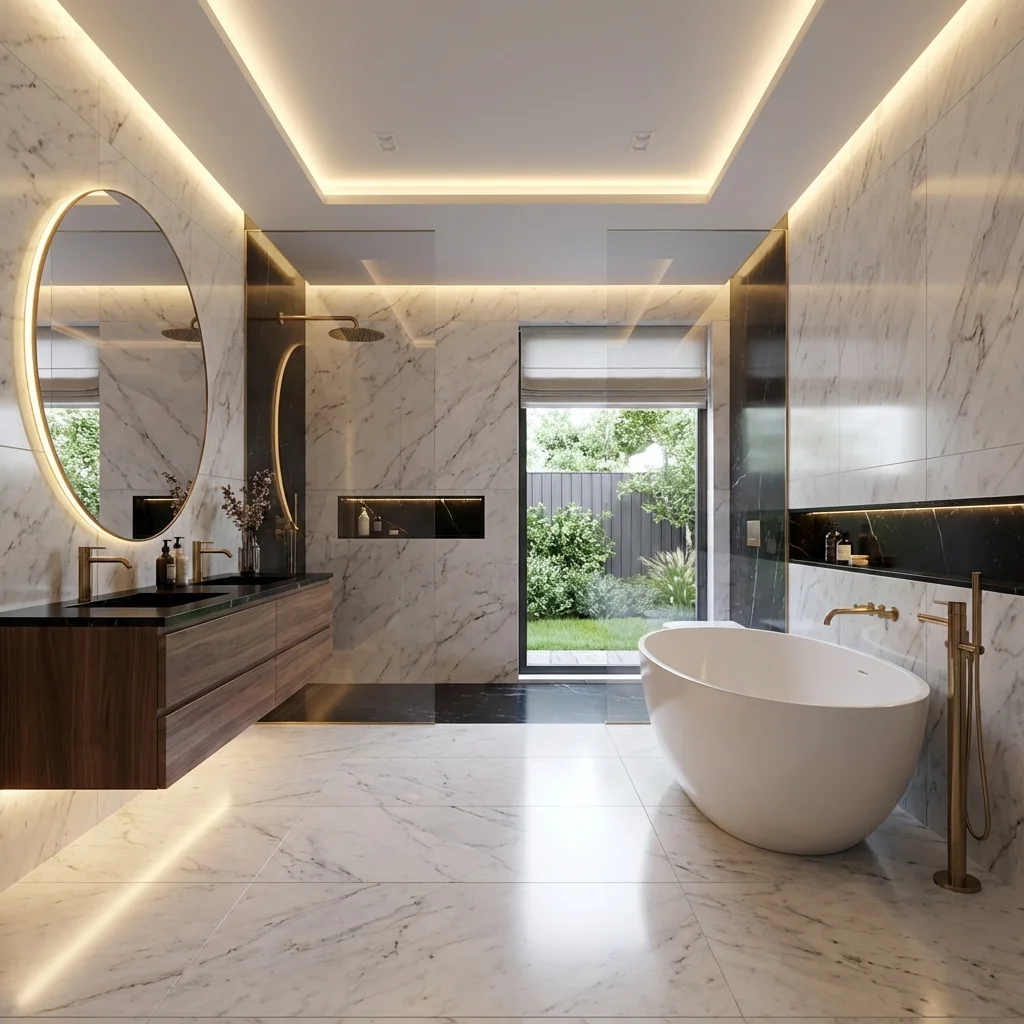
When selling high-end luxury real estate off-plan, clients need interior visualizations that communicate premium quality and material depth before construction even begins. This marble bathroom render exemplifies that process.
The Challenge
The project involved a high-end luxury interior visualization where the material palette was non-negotiable: honed Nero Marquina marble, brushed brass fixtures, and fluted glass partitions. The visualization needed to convey immediate architectural prestige to potential investors who would never see the property physically prior to making a decision.
The key technical challenge was material authenticity. Black marble is notoriously difficult to render convincingly — the veins must feel geological, not generated. Additionally, the complex lighting scenario involved a dramatic skylight, warm accent lighting from brushed brass fixtures, and cool ambient daylight fill. Balancing all three independent light sources without color contamination was the central focus.
The Approach
Every architectural element was modeled to real-world dimensions using the provided floor plan schematics — from the exact thickness of the marble tiles to the real-world scale of the minimalist fixtures. This absolute precision allowed actual manufacturer product data sheets to guide the integration of the modeled assets.
For the marble surface, I utilized a combination of high-resolution displacement maps and carefully tuned roughness node setups. The objective was to capture a "honed" quality — matte and velvety rather than highly polished — which required compressing the specular response while preserving the optical depth of the stone veins. Multiple texture passes at varying scales ensured natural variation.
The lighting architecture relied on baking three distinct volumetric light sources before final compositing. This included the emotional warmth from the artificial brass fixtures, the cool daylight contrast entering the space, and the dramatic natural top-light washing over the marble surfaces. The final pass included subtle post-processing to refine the local contrast and color grading.
The Result
The final atmospheric renders were delivered in extreme 4K resolution, optimized perfectly for both high-end print brochures and digital luxury property listings. The image suite effectively sold the high-end lifestyle long before the space was physically built.
By presenting an uncompromising level of photorealism and precise architectural lighting, the visualizations bridged the gap between raw concept drawings and emotional buyer consensus.
Key Takeaways
- Real-world scale modeling is non-negotiable for architectural visualization — buyers instinctively sense when proportions are wrong
- Material authenticity (especially marble, metals, and glass) is what separates a "rendered" look from a photorealistic image
- Lighting is 80% of the emotional impact — technical accuracy serves the mood, not the other way around
- Interior visualization directly accelerates sales cycles for off-plan properties by helping buyers commit emotionally
Have a property or space you'd like to visualize?
Let's Talk